
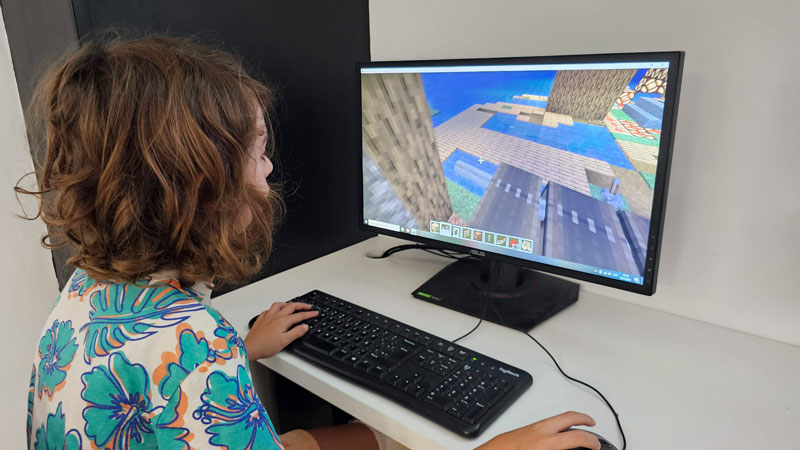
It’s becoming increasingly common for kids to come home with one exciting idea in mind: creating their own video game. Sometimes the inspiration comes after playing Minecraft, Roblox, or Fortnite. Other times, it’s sparked by watching a content creator explain how games are made. Whatever the source, many parents end up asking the same question: where should my child start if they want to make video games?
The answer often comes as a surprise. While video games also rely on design, music, artwork, and storytelling, programming is the foundation that every game is built on. It’s programming that allows a character to move, an enemy to react, a scoring system to work, and every player action to trigger a consequence.
That’s why, if a child wants to learn how to create video games, the best place to start isn’t by mastering a specific game engine or software tool—it’s by understanding how programming works. With that foundation, they’ll be able to bring their own ideas to life and discover that making a video game involves much more than writing code. It also requires creativity, planning, problem-solving, and a willingness to experiment.
What does it take to create a video game?
Every video game begins with an idea. It can be as simple as helping a character collect objects or as ambitious as building an open world filled with quests. But no matter how good the idea is, it can’t come to life on its own.
For a character to move, an enemy to react, or a player to earn points, every one of those actions has to be programmed.
Programming is the language that tells a computer exactly what to do at every moment. Without it, a video game is nothing more than a collection of images with no interaction. That’s why programming is usually the very first step for children who want to learn game development.
Creating video games means creating, imagining, and designing
Although programming is the foundation, building a video game is about much more than writing code. It means coming up with a story, designing characters, planning levels, deciding what challenges players will face, and making sure the experience is fun and engaging. Even in simple projects, children make creative decisions every step of the way.
This combination of logic and creativity is one of the greatest strengths of game development as a learning experience. Instead of completing programming exercises with no real-world context, children build projects inspired by their own imagination.
Every small milestone has a purpose and produces a visible result, which keeps motivation much higher than in many other learning environments.
Programming makes more sense when there’s a real goal
One of the biggest challenges in learning any new skill is staying motivated throughout the process. Video game development changes that dynamic. Children aren’t learning programming because they have to memorize concepts—they’re learning because they want their character to jump higher, introduce new enemies, or make the next level even more exciting.
Programming stops feeling like an abstract subject and becomes a tool for creating something meaningful. That motivation encourages many children to tackle increasingly complex challenges without even realizing it, because every new concept they learn brings them one step closer to the game they’ve imagined.
Much more than learning to code
As children build a video game, they develop skills that extend far beyond programming.
They learn how to break complex problems into manageable steps, find solutions when something doesn’t work, and refine their work until they achieve the desired result. They also build patience, persistence, and the understanding that mistakes are simply part of the learning process.
At the same time, they strengthen their creativity. Every decision—from designing a character to defining the game’s rules—requires imagination, experimentation, and continuous improvement.
That’s why video game development brings together two abilities that are often seen as opposites: logical thinking and creativity. In reality, they work hand in hand to transform an idea into a fully functioning project.
Where should a child begin?
Many parents assume that creating video games means learning complex programming languages right away. In reality, the best approach is to start with age-appropriate tools that introduce the core concepts of programming gradually.
As children gain experience, they can move on to more sophisticated projects and more powerful programming languages, always building on a solid foundation of computational thinking and problem-solving.
The goal isn’t to learn a specific programming language as quickly as possible. It’s to understand the logical principles that all software and video games share.
Video games are just the beginning
Not every child who learns to create video games will go on to work in the gaming industry—and they don’t need to.
The real value lies in discovering how to create technology instead of simply consuming it. Through game development, children learn programming, strengthen their creativity, improve their problem-solving skills, and develop a way of thinking that will benefit them in virtually any field.
In that sense, video games aren’t the destination—they’re a gateway to programming and many other areas of technology.
Turning a hobby into a learning opportunity
When a child says they want to create video games, they’re expressing something much more meaningful than a simple hobby. They’re showing curiosity about how things work and a desire to build something of their own.
Supporting that interest with the right learning environment can help them discover programming in a natural and engaging way while developing valuable skills such as creativity, logical thinking, problem-solving, and perseverance.
At Codelearn, video game development is an integral part of the learning journey because it provides an engaging, motivating context for learning to code. The goal isn’t simply for students to build their first games—it’s to give them the skills, confidence, and mindset they need to keep creating, learning, and taking on new technological challenges in the future.