
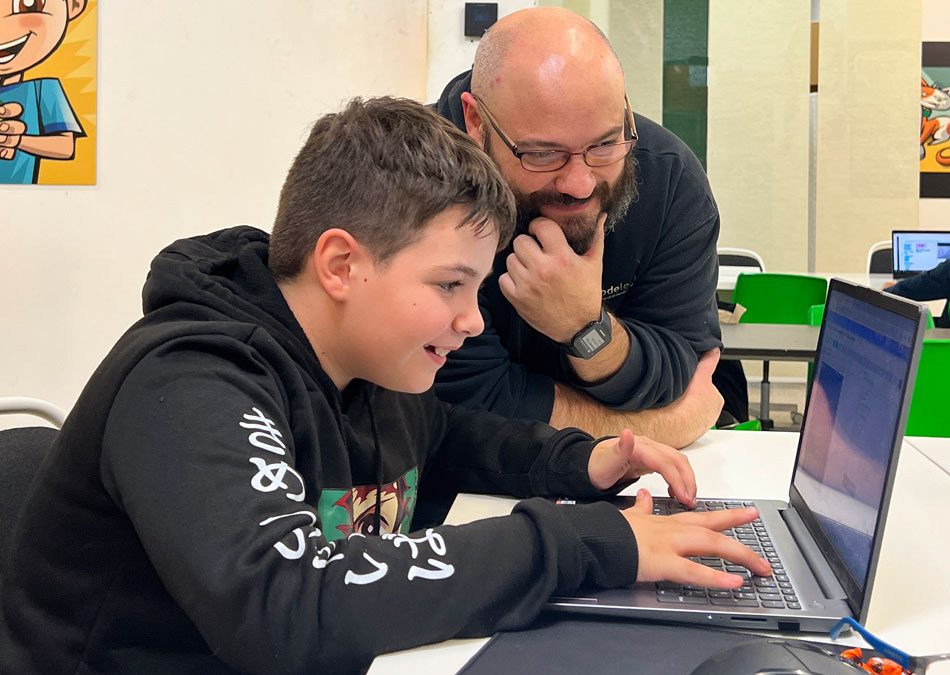
Learning to program isn’t just about writing code or knowing how to use a computer. In reality, when children start programming, they’re developing an entirely new way of thinking—one that’s more structured, more logical, and more creative.
Programming provides an environment where problems aren’t solved through intuition or random trial and error. Instead, they are approached through clear steps, logical sequences, and well-defined goals. That’s why its educational value extends far beyond technology: it directly shapes the way children think, analyze, and learn.
A new way of understanding problems
One of the most valuable skills children develop through programming is the ability to break complex problems down into smaller, more manageable parts.
Rather than viewing a challenge as one overwhelming task, they learn to divide it into individual components that can be solved one at a time. For example, creating a video game stops being an abstract idea and becomes a collection of smaller elements: characters, rules, movement, scoring, and player interactions.
This way of thinking, known as computational thinking, isn’t limited to programming. It naturally transfers to subjects such as math and science, as well as everyday tasks that require planning, organization, and problem-solving.
Logical thinking: learning to reason step by step
Programming develops logical thinking in a very direct way. Every instruction has a specific order, a consequence, and an expected outcome. This encourages children to think sequentially and understand how even small changes can completely affect the final result.
Over time, they develop a more analytical mindset. They begin recognizing patterns, anticipating outcomes, and building solutions based on clear, logical structures.
This type of reasoning isn’t only valuable in technology-related fields—it’s useful in any situation that requires organized, evidence-based decision-making.
Learning that mistakes are part of the process
In programming, making mistakes doesn’t carry the same negative connotation it often does in other learning environments. When something doesn’t work, it simply doesn’t work, making it easier to identify what went wrong and why.
This changes the way children perceive mistakes. Instead of seeing them as failures, they begin to view them as valuable feedback that’s simply part of the learning process.
Testing, making adjustments, and trying again quickly become second nature. Over time, this strengthens perseverance and reduces the fear of failure—one of the biggest obstacles to effective learning.
Creativity applied to technology
Although programming is often seen as a technical discipline, it’s also a highly creative one. Children don’t just follow instructions—they design their own projects, create games, animations, and interactive stories, and turn abstract ideas into something tangible and functional.
Creativity in programming isn’t about improvising without structure. It’s about finding original solutions within a set of rules. This balance between creativity and logic is what makes programming such a powerful educational tool.
Understanding the digital world they live in
Today’s children grow up surrounded by technology: apps, video games, digital platforms, and even artificial intelligence tools. Yet most use these technologies without understanding how they actually work.
Programming changes that relationship. It helps children move beyond being passive users and begin to understand—even at a basic level—what happens behind the digital tools they use every day.
As a result, they not only build technical knowledge but also develop a more informed, critical perspective on the digital world around them.
Building independence, confidence, and persistence
As children progress, they discover they’re capable of creating projects on their own. That sense of accomplishment has a direct impact on their confidence.
Programming also requires persistence. Not every solution works the first time, so children learn to explore alternatives, research new ideas, and experiment until they achieve the desired outcome.
This process strengthens both independence and self-directed learning—two essential skills in a world that’s constantly evolving.
Much more than a technical skill
Many people associate programming exclusively with careers in technology, but its true value goes far beyond that. The skills children develop through programming—logical thinking, problem-solving, structured creativity, and resilience in the face of mistakes—are valuable in virtually any academic subject or future career.
For that reason, programming is better understood not simply as a technical skill, but as a way of learning how to think.
When children learn to program, they’re not just learning how to write code. They’re developing a more structured, logical, and creative way of thinking. They’re learning how to break down problems, persevere through challenges, build effective solutions, and better understand the digital world around them. And while not every child will grow up to work in technology, every child can benefit from learning to think this way.
At educational organizations such as Codelearn, this type of learning is introduced progressively, combining logic, creativity, and problem-solving so children don’t simply learn to code—they develop skills that will serve them well, whatever path they choose in the future.