
“They’re always glued to a screen.” It’s a phrase parents say every day. Video games, YouTube, social media, and apps are part of children’s everyday lives, so it’s only natural to wonder whether all that screen time is healthy or if it could affect their development.
The truth is that the answer doesn’t depend only on how much time children spend in front of screens. It also depends on what they’re doing during that time. There’s a big difference between passively consuming digital content and using technology to create, experiment, and build something of their own. That difference can completely change the way children interact with technology.
Is it bad for children to spend a lot of time in front of screens?
When people talk about screen time, the conversation usually focuses on the number of hours. Setting age-appropriate limits is certainly important, and children also need time to play outdoors, read, exercise, relax, and spend time with family.
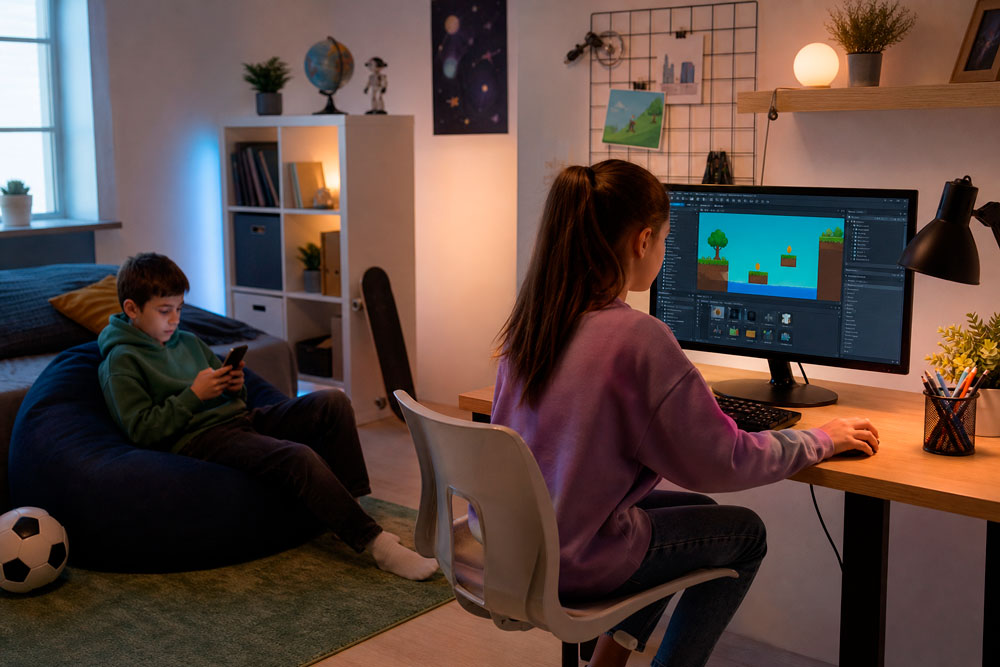
But there’s another question that’s just as important: What kind of screen time are they having? Watching videos for an hour is very different from spending that same hour designing a video game, programming a robot, editing a video, or building an app. In both cases, a screen is involved, but the learning experience is completely different.
When children create instead of simply consume, they become active participants in their own learning.
What’s the difference between consuming technology and creating it?
Today’s children grow up surrounded by technology. They know how to install apps, find videos, play online games, and communicate with friends. Those are valuable digital skills, but they don’t necessarily mean children understand how technology actually works.
Learning to create technology changes that perspective. Children discover that every video game, website, and app exists because someone had an idea and turned it into reality. That shift in mindset is incredibly valuable. The computer stops being just a source of entertainment and becomes a place where children can imagine, experiment, and bring their own ideas to life.
Why is coding one of the best ways to make screen time meaningful?
Coding is one of the best examples of active screen time. When children create a video game, an animation, or a simple app, they aren’t just writing code. They’re thinking about what they want to build, planning each step, testing different solutions, and fixing problems along the way.
Without even realizing it, they’re developing skills that go far beyond technology, including logical thinking, creativity, problem-solving, perseverance, and goal-oriented learning.
The difference is that these skills aren’t learned through theory alone. Children develop them while creating something they genuinely care about.
Creating technology is a different way of learning
Children are naturally more engaged when they’re building something of their own than when they’re simply consuming content.
Designing a video game, bringing a character to life, creating an interactive story, or programming a robot presents real challenges that spark curiosity and encourage continuous learning.
This kind of project-based learning is especially powerful because it combines technology with creativity. Instead of asking, “What can I do with this device?” children begin asking, “What can I create with this technology?”
How can parents encourage this mindset?
Parents don’t need to know how to code to help their children develop a more creative relationship with technology. Sometimes it’s enough to show interest in the games they enjoy, ask them how they think those games were made, or encourage them to imagine how they would design their own version.
It’s also helpful to give children opportunities to create instead of simply consume. That could mean programming a simple video game, building a robot, editing a video, or working on any age-appropriate digital project.
The goal isn’t to eliminate screens from children’s lives. It’s to help them discover that screens can also be tools for creativity, learning, and innovation.
Making screen time more meaningful matters more than simply reducing it
Technology will continue to play a central role in children’s lives, both inside and outside the classroom. That’s why the real challenge isn’t avoiding screens altogether—it’s helping children learn to use technology in a thoughtful, creative, and purposeful way.
When children move from consuming technology to creating it, they also change the way they learn. They begin to understand that behind every app, every video game, and every digital tool are ideas, knowledge, and people who made them possible.
At Codelearn, this philosophy is at the heart of everything we do. Our students don’t just learn how to use technology—they learn how to understand it, create it, and turn their own ideas into real projects. Because the future won’t belong only to those who know how to use technology, but also to those who know how to imagine it and build it.