
One of Minecraft’s most distinctive features is neither immediately visible nor constantly perceived: its music. Unlike most video games, where the soundtrack continuously guides the player’s emotions, Minecraft adopts a radically different approach. Its music comes and goes, loops without warning, and is often absent altogether—until, suddenly, it completely transforms an otherwise ordinary moment.
A soundtrack designed not to impose itself
The German composer Daniel Rosenfeld, known as C418, has explained in several interviews that his goal was never to create a traditional video game soundtrack. In conversations with specialized media outlets, Rosenfeld has noted that Minecraft’s music was meant to feel “as if it were already there” rather than something the game actively imposes on the player. For that reason, many of the pieces were composed with simple structures, slow tempos, and minimal instrumentation, relying primarily on soft synthesizers and processed piano sounds.
This approach aligns with the vision of Markus “Notch” Persson, the game’s creator: Minecraft has no fixed narrative and no “mandatory” emotional beats. The player decides what matters and when it matters. The music, therefore, could not dictate an external rhythm; it had to adapt to each player’s personal experience.
How does music actually work in Minecraft?
Music in Minecraft is not designed to accompany the player’s actions continuously. Unlike other video games, there is no constant soundtrack or predefined musical sequence. Instead, the game uses an intermittent playback system, intentionally built to alternate between long periods of silence and occasional musical appearances. This system works as follows:
- Tracks do not play continuously
- After a piece ends, a long stretch of complete silence may follow
- The next track is selected at random from a set, depending on the game’s general context (surface, caves, etc.)
- There are no transitions or warnings: the music simply begins
This design means that players do not perceive music as a permanent element of the game, but rather as something almost accidental. Often, players can spend long minutes building, exploring, or surviving without being aware of the absence of music—until it appears and redefines the moment.
The power of silence and the unexpected
Precisely because of that prolonged absence, when the music does appear, its emotional impact is far greater. C418 has commented that he was interested in exploring the relationship between silence and sound—something uncommon in video games, where audio is usually constant.
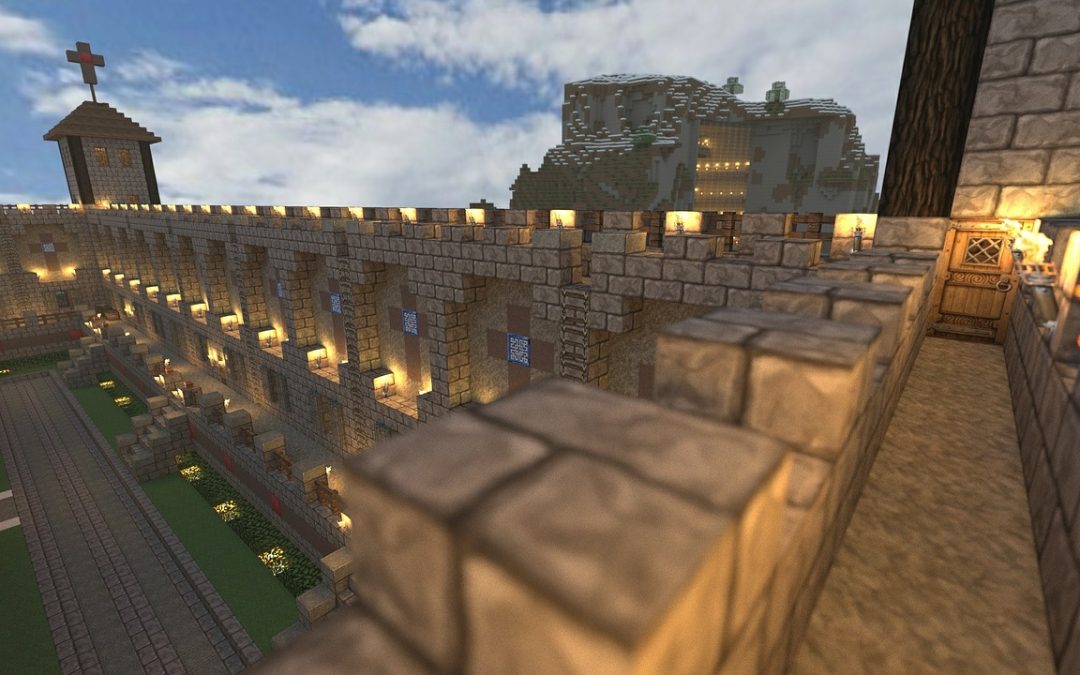
Imagine the situation: you have been exploring a landscape at dusk for some time, placing blocks, with no musical accompaniment at all. Suddenly, an instrumental piece begins to play. Mechanically, nothing in the game has changed, but the experience is transformed. That entirely emergent moment can feel intimate, melancholic, or even epic, despite the lack of any explicit objective on screen.
The music does not create the moment; it reveals it.
Music the player does not always “hear”
Another key trait is that Minecraft’s music often operates on a subconscious level. The composer himself has acknowledged that he was comfortable with the idea that players might not actively pay attention to the music. In fact, that was part of the design: if the music stands out too much, it breaks immersion.
This is why many people remember Minecraft’s music with a sense of nostalgia that is hard to explain. It is not so much that they recall when a specific track played, but how they felt when it appeared. The soundtrack becomes associated with personal, unique moments rather than with scenes predefined by the game.
A soundtrack impossible to synchronize
In more traditional games, music is carefully synchronized with events: combat, victories, defeats. In Minecraft, this does not exist. Two players may hear the same piece in completely different situations: one might be safe inside their home, while another is lost on a distant expedition.
This design reinforces a core idea of the game: every experience is unique and unrepeatable. The music does not accompany a written story, but millions of small stories created by each of the players who inhabit this universe.
When the music appears, it matters
Minecraft’s music does not seek constant attention. It functions as a system of open loops, extended silences, and random appearances that respect the player’s own rhythm. Sometimes it goes unnoticed for hours; other times, it arrives at precisely the right moment to turn a simple scene into something emotionally powerful.
That is probably one of the reasons why the game’s soundtrack has left such a lasting mark: it does not tell us what to feel, but when it plays, it reminds us why we are there.